Group_Arrival

By Eleanor Harte


A small group of college students stands in a circle around a pile of lumber, fitting construction helmets on their heads and pulling on work gloves as they listen to a man holding a saw give instructions. A few of the students shiver as a cold wind rips through the group, but they continue to listen intently. As the man finishes talking, they break apart and begin to pick up tools: a drill, a hammer, a ladder. They get to work, and suddenly it’s hard to hear anything over the roar of the saw and the sound of nails being hammered into wood.

House

The students are in eastern Kentucky, spending their spring break repairing homes and building new ones for families in need. A group of 15 UMass Amherst students in the Newman Students Association chose to go on the alternative spring break trip last month. Led by Fr. Jon Reardon, they drove to Kentucky over the span of two days – they stopped in Pittsburgh overnight.

Girls

Lindsey Russo said she was inspired to participate in alternative spring break because of her history with community service. “I went on a trip to Neon, Kentucky in high school and I really liked it,” Russo said enthusiastically. “It was the best experience I had in high school. I went to Catholic school and I felt it was the best way to live out my faith in action. Alternative spring break has allowed me to discover the true meaning of Christ in my daily life.”

The group worked with a nondenominational Christian organization, the Christian Appalachian Project, which provides physical, spiritual, and emotional support to people in need living in Appalachia. They participated in CAP’s alternative spring break program, Workfest 2013, which provides students with an alternative spring break program and at the same time allows CAP to finish projects on a much quicker schedule than they would be able to do with their regular long-term volunteers.

working on gutter

Russo’s team built a porch and added a bedroom onto a house for a man awaiting a heart transplant, even braving a thunderstorm one afternoon to continue the work. “Working in tough conditions showed me how much we rely on God and each other. Material things start to lose their value.”

Students worked in teams with students from other schools, building porches, additions to houses, and repairing roofs. Mireille O’Connor was on a team that added siding and outside insulation to the home of an older couple who had built their home over 30 years ago, but now found themselves with a leaky roof and a home that was cold in the winter.

front of house

“The family’s reactions were really touching. The couple’s children and grandchildren were so thankful that we were helping them,” O’Connor said, smiling as she described the family, who she grew to really care for over the week.  “One of the best parts was when the family hugged us and how they really cared for us. They cooked us chili hot dogs and vegetable pizza, macaroni salad, even butterscotch cake and cupcakes. They were so nice. I didn’t want to leave them. I wish we could be there to see the end of the project.”

The project should be finished in the next few months. Even though she won’t be there to help finish the project in person, O’Connor is thankful she got the chance to work on it. “I had never done a service trip before and I always wanted to do one because you get to see firsthand the reactions of the families because they’re there. The other type of volunteer work I usually do is fundraising for things, and I never really get to see what the hard work is going toward.”

Group_Breakfast

Alec Bergweiler went on the trip because his friend had a good experience on a similar trip with the NSA last year. “I wanted something else to do for spring break other than sitting at home doing homework,” said Bergweiler.  He worked on the home of an older couple plagued with medical problems – first, the husband had three heart attacks, and then the wife was diagnosed with leukemia. “She’s in remission now, but their medical bills were really high,” Bergweiler said, which caused the couple to spend the money they planned to use for home repairs on medical treatment. CAP stepped in to help the family with the repairs.

House2

O’Connor calls the trip her best UMass memory. “I think learning to work together with all different types of people throughout the trip and getting to know them while helping the family at the same time was the best part.” The diversity of the volunteers was an aspect she appreciated as well. “It was really cool how all the helpers came from different walks of life but had the same common goal of wanting to help the family and really worked together to achieve that.”

Bergweiler did things in Kentucky that he had never done before. “I got up on the roof, knocked down a chimney with crowbars, added siding to the house, and put a metal roof over the existing shingle roof.

Seeing eastern Kentucky was also a highlight for Bergweiler. “We went to the original KFC restaurant, and Cumberland Falls, which was cool because I don’t see waterfalls very often.” Cumberland Falls is known as the “Niagara of the South,” and is located close to the camp where the group stayed.

Group_KFC

“My favorite part was how friendly the people we were helping were. They were very down to earth, and getting to know them was nice. The husband talked to me about how he was a firefighter and flew planes – he had a really full and interesting life.” Students often talked to the homeowners while working and on lunch breaks. They shared stories of faith and life at college and learned about life in Kentucky.

Bergweiler says he would definitely go on a similar trip again. “We improved the homeowners’ lives through direct impact, which was great.”

Lynn Pham found out about the trip through a friend. “It was a great bonding experience. I made a lot of new friends from UMass, who I never would have met otherwise. One of my favorite parts was playing games, like Taboo, a group word game, kind of like charades where people shout things out – it was a lot of fun.”

House_Mirielle

Pham has participated in a number of service projects before, but none made as big of an impact on her as Workfest 2013. “I’ve done food pantries, given donations, and worked at nursing homes. But I wanted to see my actual volunteer time being given to needy people as well as see the impact that I was making.”

By Elaine Y. Olive

Editor’s note: Elaine, a member of Sacred Heart Parish in Springfield, wrote this poem as a Thank You to the staff a the Mont Marie Health Care Center in Holyoke. She wanted to show her appreciation “for all the wonderful care they have given and still continue to give” to her mother, Bertha R. Paquet, age 98. Bertha has been a resident there since August, 2011. Elaine also taught at the former Sacred Heart School for 16 years.

Elaine notes: “I wrote it especially for the Mont Marie staff, but I also was thinking of all the unsung caregivers in our skilled nursing care facilities and hospitals.”

Bertha R. Paquet

Bertha R. Paquet


Holy, Holy, Holy

Holy, Holy, Holy

are crooked smiles

on vacant faces,

sunken cheeks

and toothless grins,

eyes closed

as one drifts

between this world

and the next.


Holy, Holy, Holy

are voices who speak

but make no sense,

who repeat, “So, what’s

new with you?” all day,

who smile at everyone

not knowing anyone.

Holy, Holy, Holy

are aluminum walkers

with bright tennis ball

feet allowing frail guides

an easier walk

down the hall and back,

down the hall and back.

walker

Holy, Holy, Holy

are customized wheelchairs

providing comfort and

support to atrophied

limbs and bodies

unable to right themselves.

Holy, Holy, Holy

are chair alarms

signaling an unsafe move

of one attached,

call bells loudly ringing

requesting help to care

for once private needs,

televisions blaring for

ears no longer able to hear.


Holy, Holy, Holy

are lamb’s wool

- Depends

- Adaptive eating utensils

like scoop bowls,

sippy cups,

special spoons

- bibs, called clothes

protectors

- pureed food

- hearing aid batteries

- portable oxygen tanks

- medications

- commodes

- stool softeners

- Ensure


Holy, Holy, Holy

are wandering souls

once pillars of society

many now forgotten

within this home

Blessed are you, Angels

of Mercy, who care for

their most basic needs,

for protecting them,

for supporting them,

for loving them as your won.

Blessed all hallowed souls

within these sacred walls and

halls, staff, caregivers and

residents alike,

Holy Holy, Holy are you.

Mont marie wide early spring 2011

Camden_NJ_poverty

Camden street scene

By Peggy Weber

When I told people I was journeying to Camden, New Jersey to interview Salesian Brother Mickey McGrath, the response was not a positive one.

Oh, people are impressed with the beautiful art work of Brother Mickey and they are excited that he will be visiting our diocese on May 21 and 22. However, most people said something to the effect, “Camden! Do you know that city is the murder capital of America?”

Brother Mickey at work

Brother Mickey at work


mickey working

Honestly, I didn’t know much about Camden. To me it was a sign on the New Jersey Turnpike that told me I was closer to Delaware. It was a landmark on the many trips I made to Washington, D. C. when my daughter lived there.

My son said he mentioned my trip to someone from New Jersey and that person said, “Is your mother bringing a body guard for the interview?”

I mentioned all of this to Brother Mickey when we arrived at the downtown Cathedral of the Immaculate Conception. The big iron gates that protect the rectory certainly indicated that Camden might be living up to its reputation. The vacant convent and people sleeping on doorsteps also clued us into the state of things. And the lack of activity in the downtown area certainly showed us that Camden has difficulties.

Sure the aquarium along the riverfront looked busy. However, as one gazed across the Delaware River to Philadelphia it looked like the Emerald City of Oz in comparison to poor Camden.

view of philly

View of Philly

“Camden is a very seriously challenged city. It had the highest murder rate in the country last year. And it is among the top five of poorest cities int he country, “said Brother Mickey from his Bee Still Studio.

http://www.beestill.org/

Recent census figures show that the population had continued to decline to 77,000. About 52 percent of those live in poverty.  The per capita income for Camden was $9,815 compared to the national average of $21,587.

You get the idea.

One could be depressed. However, I left Camden with great feelings of energy, inspiration and hope!

Why?

nice of mickey at door

Brother Mickey McGrath at his studio door

Well, there is Sacred Heart Parish in Camden. Under the leadership of Msgr. Michael Doyle, this parish provides a Catholic School, many creative programs and a voice for the voiceless.

http://sacredheartcamden.org

Brother Mickey told me that he came to Camden because Msgr. Michael invited him and because they both believe “that beauty heals and everyone is attracted to beauty!

Original art at Sacred Heart Parish

Original art at Sacred Heart Parish

And, of course, there is Brother Mickey — creating great art work in a row house near the parish.

“My ministry as an artist is to create beauty  and to help others see beauty, especially in the unexpected places,” he said.

Mickey making beautiful art!

Mickey making beautiful art!

He recently exhibited paintings of Camden that show this beauty — even in abandoned buildings.

And he wants people to know there is a heart to Camden.

Community Garden

Community Garden

“It’s not just all murder and mayhem. It’s families trying to make a go of it!”

Another positive sign in Camden is Hope works, founded by Jesuit Father Jeff Puthoff to provide technical skills to Camden’s youth.

http://www.hopeworks.org/

Now I am not planning my summer vacation in Camden but I learned on a gray, overcast Saturday that there is a lot of good there and I am glad I went.

Follow Peggy Weber on Twitter @spunfromtheweb.

Surely, a sign of hope!!!

Surely, a sign of hope!!!

By Peggy Weber,  Class of 1972

cathedral graduation 086

Two years ago, Cathedral High School sent one of its graduates off to Harvard University. That is quite an accomplishment since reports show that only 6 percent of applicants are accepted.

Last year, the class valedictorian for Cathedral was accepted at Harvard. And this year one of Cathedral’s students has already been accepted to Tufts University.

The school has initiated the International Baccalaureate Diploma Programme (IB) which is praised by college admissions offices. There are plays, service projects, and even an astronomy club!

However, people don’t seem to be talking about those amazing accomplishments.

There is so much good going on at that school. Young people are getting a quality, faith-filled education. They are in a caring community.

Yes, they are not in their building on Surrey Road — YET! The Diocese of Springfield is fighting vigorously to get a just settlement so the school can be re-built properly.

I am not a patient person but I realize that anything involving lawyers takes time.

Sadly, as schools throughout the Diocese of Springfield celebrate Catholic Schools week I sense  an undercurrent of dismay and in some places despair about Cathedral High School.

I have heard comments. I have read letters in the newspaper. I have seen the pain on people’s faces.

None of us can speed up the settlement talks. But we can talk up the school. The Diocese is working to re-build Cathedral and people need to be positive and promote this wonderful place.

Right now the Cathedral community — and I count myself among that group — can do some things.

cathedral logo

We can encourage young people to attend this great school that gets its students into Harvard and other fine schools.

We can make a donation to help a family send their kids to Cathedral.

We can speak up and say positive things when we hear talk against Cathedral. This great school, which began in 1883, is still serving the area well.

We can pray! It helps.

And we can cheer on the number one boys’ hockey team in the state!

GO PANTHERS!!

Please spread this message and turn the tide of negativity and be a positive force for Cathedral.

Log onto http://www.cathedralhigh.org for information about admissions, donations or any other way you can help.

Last year's team at Fenway!

Last year’s team at Fenway!

Image


By Peggy Weber

When my daughter, Kerry, was in First Grade she was worried about when she would lose her first tooth. Everyone else in the class, she said, had lost a tooth! It was true. She was slow to get them and even slower to lose them.

Happily in the spring of first grade the first one finally came out.

Image

In the meantime, she had learned how to perform a cartwheel and got to show that skill with some of her classmates at the annual Holy Cross Musical.

It is this kind of “stuff” that kids and parents should remember about First Grade – not what families in Newtown, Conn. are recalling. Children should worry about losing teeth not the trauma of a gunman killing their classmates.

As the events of Dec. 14th unfolded, I kept thinking that the slaughter of young students could not have happened. What kind of troubled person would do something like this? And why?

I have no answers.

But I have found comfort watching and listening to the prayerful responses to such a horrific event. And I was especially inspired when watching Monsignor Robert Weiss, pastor of  St. Rose of  Lima Catholic Church in Newtown.

Image

He has made me proud to be Catholic. It has been wonderful to see what a caring and kind pastor he is during such an awful time. There are no classes in the seminary on how to handle something like this. He has been a brick. And his parish has responded in so many beautiful ways — including the planning of  special Mass the night of the shooting.

Image

I checked out the parish web site. Indeed, they have an impressive and active community.

On the site, they have been posting comments from people to the parish.

One was quite poignant. It was from Monsignor Basil O’Sullivan, an Irish priest living in Scotland. He sent condolences from the Dunblane, Scotland where a horrific shooting took the lives of many small children in March, 1996.

Image

The following link is their sympathetic message.

http://www.strosechurch.com/from-scotland/

It made me realize that there evil persists. But it also showed me how good people can be during terrible times.

It is to that I cling.

VICTIMS OF SANDY HOOK ELEMENTARY SCHOOL SHOOTING MASSACRE

The following is a  version of a homily given at Our Lady of the Cross Parish in Holyoke this past weekend by Conventual Franciscan Father Albert Scherer,  parochial vicar.

3rd Sunday of Advent


I am sure all of you have watched the news the past couple of days regarding the shooting that took place in Connecticut on Friday.  I am also sure that you were moved with compassion and sadness by the heart-wrenching images that you saw:

-      children with their eyes closed – their hands upon the shoulders of the student in front of them – being led out of the school by their teacher

-      the look of horror on the face of a relative

-      an emotional President brushing away a tear

-      the presence of so many police officers and state troopers

-      a grieving Pastor, who stated that he had baptized some of the children who were killed; a few who were preparing for their First Communion

There were two other images that struck me:

-      one was a scene of the local Methodist church where the church doors were open wide – inviting people to come inside to pray

CROWD SURROUNDS CATHOLIC CHURCH IN CONNECTICUT COMMUNITY ROCKED BY SCHOOL SHOOTING

-      the other was the scene of the Catholic church – St. Rose of Lima – where hundreds of people gathered inside for a prayer vigil and hundreds more gathered outside because there wasn’t enough room inside.

In the face of such a tragedy, when individuals feel so utterly helpless, they still have a desire to do something, to do anything.  And so, they go to a church to pray; they create shrines  -  placing flowers, lighting candles, bringing stuffed animals; they lower a flag to half staff; they make signs  -  Hug a teacher today, Our love, thoughts and prayers are with you.

ROSE SET ON CROSS AT MEMORIAL TO SANDY HOOK ELEMENTARY SHOOTING VICTIMS

My sisters and brothers, even though we do not live in Newtown, we feel the anguish of those residents.  Our hearts ache for them, and with them!  Our hearts may ache a little more compared to other shootings that have taken place in other schools in our country because this time we are mourning children – six and seven year olds – innocent children – 12 little girls and 8 boys, killed just days before we celebrate Christmas.

Today is the 3rd Sunday of Advent, traditionally called Gaudete Sunday – thus the reason for the rose colored candle in the Advent wreath and the rose vestments that I am wearing.  Gaudete Sunday derives its name from St. Paul’s urging of the community “to rejoice always.”  St. Paul would understand why our rejoicing is rather low-key today.

And yet, St. Paul would also remind us why we need to rejoice – even in the face of such grief; especially in the face of such grief.

The Lord is near.  The God of peace is near.

MOURNERS GATHER AT NEWTOWN'S CATHOLIC CHURCH FOR VIGIL SERVICE FOLLOWING SCHOOL TRAGEDY

My sisters and brothers, whenever such a horrific tragedy occurs, there are always some individuals who ask:  “Where was God?”  “If God is so near, how come God did not stop the shooter?”  Some of you may be wondering the same thing.  It’s a fair question.

Now isn’t the time to get into a theological discussion on “free will.”  But let’s face it – we all value our freedom!  We all value our right to choose; to make choices; to make decisions.

PAINTED ANGELS STAND AS MEMORIAL TO THOSE SLAIN IN SHOOTING TRAGEDY  IN NEWTOWN, CONN.

God will not force us to love Him.  God will not force us to love others.  God will not force us to keep His Ten Commandments.  Those are choices we must make.  Our free will allows us to make such choices.  On Friday, the shooter in Newtown violated his free will and he did so in a most grievous way.

And so we may ask:  “Where was God in Friday’s shooting?”

FAMILY PRAYS AT MAKESHIFT MEMORIAL OUTSIDE CATHOLIC CHURCH IN NEWTOWN

God was there  -  giving courage to those terrified teachers as they protected their students.

God was there  -  guiding those first responders on the scene who bravely rushed into a dangerous situation.

God was there  -  embracing each one of those children as He welcomed them into heaven.

God was there  -  and is there  -  for all those affected by the shooting.

My friends, this is our faith!  This is what Christmas is all about:  Jesus was born for us  -  for each and every one of us!  Jesus, Emmanuel, a name which means:  God is with us!  This is our faith.

My sisters and brothers, what would we ever do without our faith?  In times of tragedy, what would we do without our faith in Jesus Christ?

In times of sickness, in times of physical and emotional pain, our faith gives us strength to make it through one more day.

In times of weakness, in times of sinfulness, our faith assures us of God’s mercy.

In times of grief, our faith promises Resurrection; promises new life; promises eternal life.

In normal times, in busy times, in times of joy, in times of sadness, our faith remains a “constant” in our lives   …  Jesus, Emmanuel, remains with us always!  Our refuge, our strength, our hope.

What would we ever do without the presence of Jesus Christ in our lives?

PEOPLE VISIT MEMORIAL TO SHOOTING VICTIMS OUTSIDE CATHOLIC CHURCH IN NEWTOWN

For the past two days, as people often do in the midst of tragedy, individuals in Connecticut and throughout our country (and even the world) turned to God.  Turning to God in prayer is the most important thing that we can do!  Prayer is really the only thing we can do in the face of such a senseless tragedy.

My friends, whether here in church or in the privacy of your homes, please take the time to pray that God will bring some good out of this horrific tragedy.

Photos  courtesy of Catholic News Service.

a choir of cute angels

Our Lady of Mt. Carmel Parish in Springfield is bustling with events of the season.

Sister of St. Joseph Betty Matuszek, pastoral minister at the parish, submitted these delightful photos of the young people in the parish preparing for the annual Christmas pageant and showing off their Jesse symbol wreaths. These are sure to bring a smile!

close of joseph and mary

3 angels

proud wreath kids

side view of manger scene

Cardinal Timothy Dolan of New York,
president of the U.S. Conference of Catholic Bishops (USCCB)

Address given at the USCCB General Assembly Fall meeting on November 12, 2012.

My brother bishops,

Yes, we have “a lot on our plate” as we commence our meeting, urgent issues very worthy of our solicitude as pastors — the suffering in vast areas not far from here caused by the Hurricane of two weeks ago, the imperative to the New Evangelization, the invitation offered by the Year of Faith, and our continued dialogue, engagement, and prophetic challenge to our culture over urgent issues such as the protection of human life, the defense of marriage, the promotion of human dignity in the lives of the poor, the immigrant, those in danger from war and persecution throughout the world, and our continued efforts to defend our first and most cherished freedom — all issues calling for our renewed and enthusiastic commitment.

But I stand before you this morning to say simply: first things first. We gather as disciples of, as friends of, as believers in Jesus Christ, our Lord and Savior, “the Way, the Truth and the Life,” who exhorted us to “seek first the Kingdom of God.”

We cannot engage culture unless we let Him first engage us; we cannot dialogue with others unless we first dialogue with Him; we cannot challenge unless we first let Him challenge us.

The Venerable Servant of God, Fulton J. Sheen, once commented, “The first word of Jesus in the Gospel was ‘come’; the last word of Jesus was ‘go’.”

Fifty years ago, on October 11, 1962, Blessed John XXIII courageously convened the Second Vatican Council “the greatest concern of which,” he insisted, “is that the sacred deposit of Christian doctrine should be guarded and taught more efficaciously.” (Allocution on the occasion of the opening of the Second Vatican Council, Gaudet mater ecclesia).

We gather for our plenary assembly in our nation’s premiere see, at the close of the XIII Ordinary General Synod of Bishops, still near the beginning of the Year of Faith. Both occasions have the same origin, the same goal expressed by Blessed John XXIII: the effective transmission of the faith for the transformation of the world.

A year ago we began our visits ad limina Petri et Pauli. I know you join me in expressing deep gratitude for the extraordinary affection, warmth and fraternal care with which our Holy Father welcomed us.

But Pope Benedict did not stop with his gracious hospitality. No. He also gave us plenty of fatherly advice — for our ministry as pastors of the Church and our personal role in the New Evangelization.

Here’s an especially striking example from his first ad limina address: “Evangelization,” the Successor of St. Peter noted, “. . . appears not simply a task to be undertaken ad extrawe ourselves are the first to need re-evangelization. As with all spiritual crises, whether of individuals or communities, we know that the ultimate answer can only be born of a searching, critical and ongoing self-assessment and conversion in the light of Christ’s truth.”

As we bishops at the just concluded Synod of Bishops confessed in our closing message:

“We, however, should never think that the new evangelization does not concern us as Bishops personally. In these days voices among the Bishops were raised to recall that the Church must first of all heed the Word before she can evangelize the world. The invitation to evangelize becomes a call to conversion.”

“We Bishops firmly believe that we must convert ourselves first to the power of Jesus Christ who alone can make all things new, above all our poor existence. With humility we must recognize that the poverty and weaknesses of Jesus’ disciples, especially us, his ministers, weigh on the credibility of the mission. We are certainly aware – we bishops first of all – that we can never really be equal to the Lord’s calling and mandate to proclaim His Gospel to the nations. We… do not hesitate to recognize our personal sins. We are, however, also convinced that the Lord’s Spirit is capable of renewing His Church and rendering her garment resplendent if we let Him mold us.”(Final Message of the Synod of Bishops to the People of God, October 28, 2012)

The New Evangelization reminds us that the very agents of evangelization – you and me — will never achieve that abundant harvest Blessed John XXIII described unless we are willing and eager to first be evangelized themselves. Only those themselves first evangelized can then evangelize. As St. Bernard put it so well, “If you want to be a channel, you must first be a reservoir.”

I would suggest this morning that this reservoir of our lives and ministry, when it comes especially to the New Evangelization, must first be filled with the spirit of interior conversion born of our own renewal. That’s the way we become channels of a truly effective transformation of the world, through our own witness of a penitential heart, and our own full embrace of the Sacrament of Penance.

II.

“To believers also the Church must ever preach faith and penance,” declared the council fathers in the very first of the documents to appear, Constitution on the Sacred Liturgy. (SC, n. 9)

​To be sure, the sacraments of initiation – - Baptism, Confirmation, the Eucharist – - charge, challenge, and equip the agents of evangelization. Without those sacraments, we remain isolated, unredeemed, timid and unfed.

​But, the Sacrament of Reconciliation evangelizes the evangelizers, as it brings us sacramentally into contact with Jesus, who calls us to conversion of heart, and allows us to answer his invitation to repentance — a repentance from within that can then transform the world without.

​What an irony that despite the call of the Second Vatican Council for a renewal of the Sacrament of Penance, what we got instead was its near disappearance.

​We became very good in the years following the Council in calling for the reform of structures, systems, institutions, and people other than ourselves.That, too, is important; it can transform our society and world. But did we fail along the way to realize that in no way can the New Evangelization be reduced to a program, a process, or a call to structural reform; that it is first and foremost a deeply personal conversion within? “The Kingdom of God is within,” as Jesus taught.

​The premier answer to the question “What’s wrong with the world?” “what’s wrong with the church?” is not politics, the economy, secularism, sectarianism, globalization or global warming . . .none of these, as significant as they are. As Chesterton wrote, “The answer to the question ‘What’s wrong with the world?’ is just two words:’I am,’”

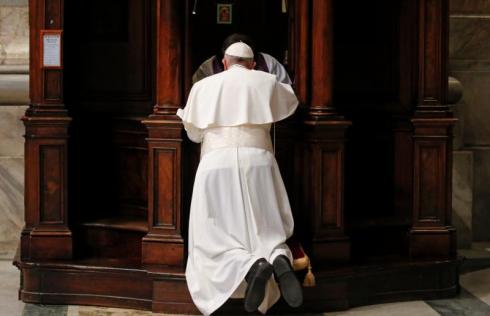
I am! Admitting that leads to conversion of heart and repentance, the marrow of the Gospel-invitation. I remember the insightful words of a holy priest well known to many of us from his long apostolate to priests and seminarians in Rome, Monsignor Charles Elmer, wondering aloud from time to time if, following the close of the Council, we had sadly become a Church that forgot how to kneel.If we want the New Evangelization to work, it starts on our knees.

Remember a few years back, when Cardinal Cahal Daly led us in our June retreat? Speaking somberly of the Church in his home country, he observed, “The Church in Ireland is in the dirt on her knees.” Then he paused, and concluded, “Maybe that’s where the Church is at her best.”

We kneel in the Sacrament of Penance because we are profoundly sorry for our faults and our sins, serious obstacles to the New Evangelization. But then we stand forgiven, resolute to return to the work entrusted to us – as evangelizers of the Gospel of Mercy.

I recall a conversation about a year ago with one of our brother bishops, newly ordained, attending his first plenary assembly. I asked his impressions of the meeting. “Well organized, informative, enjoyable,” he replied, but he went on to observe that it was one moment in particular that had the greatest impact on him. It was during our closing Holy Hour, as he entered the large room next to the chapel, to see dozens and dozens of bishops lined up to approach the Sacrament of Penance. This new Bishop told me that he felt that moment had more of an influence upon him than anything else at the meeting.

Who can forget the prophetic words of repentance from Blessed John Paul II, during the Great Jubilee, as he expressed contrition – publically and repeatedly – for the sins of the past? He mentioned the shame of the slave trade, the horrors of the holocaust, the death and destruction wrought by the crusades, the injustices of the conquest of the new world, and the violence of religious wars, to name only a few.

I remember during the celebration of the 50thInternational Eucharistic Congress in Ireland last June, when Cardinal Marc Ouellet, the Papal Legate, expressed this so forcefully as he spoke on behalf of the Holy Father at the penitential shrine of St. Patrick’s Purgatory: “I come here with the specific intention of seeking forgiveness, from God and from the victims, for the grave sin of sexual abuse of children by clerics. . . In the name of the Church, I apologize once again to the victims, some of which I have met here in Lough Derg.”

And so it turns to us, my brothers. How will we make the Year of Faith a time to renew the Sacrament of Penance, in our own loves and in the lives of our beloved people whom we serve? Once again, we will later this week approach the Sacrament of Penance.

And we’ll have the opportunity during this meeting to approve a simple pastoral invitation to all our faithful to join us in renewing our appreciation for and use of the Sacrament. We will “Keep the Light On” during the upcoming Advent Season!

The work of our Conference during the coming year includes reflections on re-embracing Friday as a particular day of penance, including the possible re-institution of abstinence on all Fridays of the year, not just during Lent. Our pastoral plan offers numerous resources for catechesis on the Sacrament of Penance, and the manifold graces that come to us from the frequent use of confession. Next June we will gather in a special assembly as brother bishops to pray and reflect on the mission entrusted to us by the Church, including our witness to personal conversion in Jesus Christ, and so to the New Evangelization.

We work at giving our people good examples of humble, repentant pastors, aware of our own personal and corporate sins, constantly responding to the call of Jesus to interior conversion. Remember the Curé of Ars? When a concerned group of his worried supporters came to him with a stinging protest letter from a number of parishioners, demanding the bishop to remove John Vianney as their curé, claiming he was a sinner, ignorant, and awkward, St. John Vianney took the letter, read it carefully … and signed the petition!

III.

As I began my talk this morning, my brothers, so I would like to end it, with Blessed John XXIII.

It was the Sunday angelus of October 28, 1962.The message the Holy Father delivered on that bright Roman afternoon never even mentions the phrase New Evangelization.But it strikes right at the heart of the mission entrusted to each of us as shepherds.

“I feel something touching my spirit that leads to serenity,” Good Pope John remarked. “The word of the Gospel is not silent.It resonates from one end of the world to the other, and finds the way of the heart. Dangers and sorrows, human prudence and wisdom, everything needs to dissolve into a song of love, into a renewed invitation, pleading all to desire and wish for the establishment of the Kingdom of Christ. A kingdom of truth and life; a kingdom of holiness and grace; a kingdom of justice, love and peace.”

How could we not see it alive in those holy men and women of every time and place, the heroic evangelizers of our faith, including most recently St. Kateri Tekakwitha and St. Marianne Cope?

We have beheld it in the Church’s unrelenting corporal and spiritual works of mercy, in the heroic witness of persecuted Christians, in the Church’s defense of unborn human life, the care of our elders and the terminally ill, advocacy for the unemployed, those in poverty, our immigrant brothers and sisters, victims of terror and violence throughout our world, of all faiths and creeds, and in our defense of religious freedom, marriage and family.

And, I have suggested today, that as we “come and go” in response to the invitation of Jesus, we begin with the Sacrament of Penance.This is the sacrament of the New Evangelization, for as Pope Benedict reminds us, “We cannot speak about the new evangelization without a sincere desire to conversion.” (Homily for the Opening of the XIII Ordinary General Synod of Bishops).

With this as my presidential address, I know I risk the criticism. I can hear it now: “With all the controversies and urgent matters for the Church, Dolan spoke of conversion of heart through the Sacrament of Penance. Can you believe it?”

To which I reply, “You better believe it!”

First things first!

PHOTOS courtesy of Catholic News Service.


By Peggy Weber

It was 18 years ago when I had the privilege of being with my father as he died from the effects of skin cancer at age 73.  At the time, I am not sure I understood what a gift he was giving to me.

Life was hectic for me, my brother and my sister and our families. Still, we each took our turn spending the night with him in our childhood home as he got ready to go home to God.

Me, my daughter, Kerry, and my parents.

My Dad did not complain. Rather, he faced the end of his life with great courage and faith. It was truly a beautiful thing to experience.

Hospice was a great help. He was not in pain and we all felt like we had a wonderful companion on our journey.

Our world today seems to want immediate solutions and no mess. Just take a pill for the pain — or 100 in the case of the Physician Assisted Suicide Bill.

My father left me with the legacy of how to have “the grace of a happy death.”

I felt the same way, in 2005 when I watched Pope John Paul II deal with his illness and death.

I encourage all who go to the polls this Tuesday to vote no on Question 2. We would be giving a gift to our families. I am grateful for what my father taught me and I pray that if I am in such a situation some day that I will have the faith and courage to die with true dignity like my Dad.

Image
 
‘FIVE THINGS CATHOLICS SHOULD KNOW ABOUT THE CATECHISM’
By Alissa Thorell
Catechism specialist for the U.S. Conference of Catholic Bishops’ Secretariat of Evangelization and Catechesis
To honor the fiftieth anniversary of the Second Vatican Council and the twentieth anniversary of the Catechism of the Catholic Church, Pope Benedict XVI has announced a Year of Faith. It began October 11, ends November 24, 2013, and is meant to strengthen the faith of Catholics and draw the world to faith by their example.
            The pope has encouraged Catholics to study the Catechism for as part of the Year of Faith. Alissa Thorell, catechism specialist for the U.S. Conference of Catholic Bishops’ Secretariat of Evangelization and Catechesis, offers “Five Things Catholics Should Know About the Catechism” to help Catholics better understand this book and its significance in their faith. Thorell explains:
            1. It’s universal in its scope. The Catechism of the Catholic Church is the first book of its kind in 450 years, an effort by the world’s bishops to convey the content of the Catholic faith to the whole Church and the whole world. Following the Second Vatican Council (1962-65), it was important for the Church to present its teachings for Catholics living in the modern world.
            2. It’s universal in its content. The Catechism compiles the living tradition of the Catholic Church and divides it into four sections: what Catholics believe (the Creed), how the faith is transmitted (worship and sacraments), how Catholics are called to live (moral life) and prayer. The contents of these four parts are interwoven, providing an organic presentation of the faith.
3. It’s a resource for education. The main goal of the Catechism is to help bishops, pastors, catechists, parents and all who teach the faith. It provides a foundation that encourages dioceses to draw their own teaching materials from it.
            4. It’s an invitation to prayer. The Catechism draws from the richness of Catholic tradition, including the lives of the saints, the teaching documents of the Church and Scripture. This makes it not only useful for learning about the Catholic faith, but for growing in one’s faith through meditation and prayer.
            5. It’s for Catholics of all ages. Learning and living the faith is an ongoing process throughout a person’s entire life, and the Catechism can help Catholics come to know and love Christ. At almost 700 pages, the Catechism can be intimidating, but it also has helpful summaries of its contents throughout, and another, the Compendium of the Catechism of the Catholic Church, gives a section-by-section breakdown of the Catechism, making it even more accessible to readers.
Image
More information on how Catholics can live the Year of Faith is available online: www.usccb.org/beliefs-and-teachings/how-we-teach/new-evangelization/year-of-faith/
Photos courtesy of Catholic News Service.
Follow

Get every new post delivered to your Inbox.